


There was a time when wearing jewellery followed a fairly simple rule. If you wore a yellow gold necklace, your earrings, bracelet, and rings were expected to be yellow gold too. But that rule does not really apply anymore.
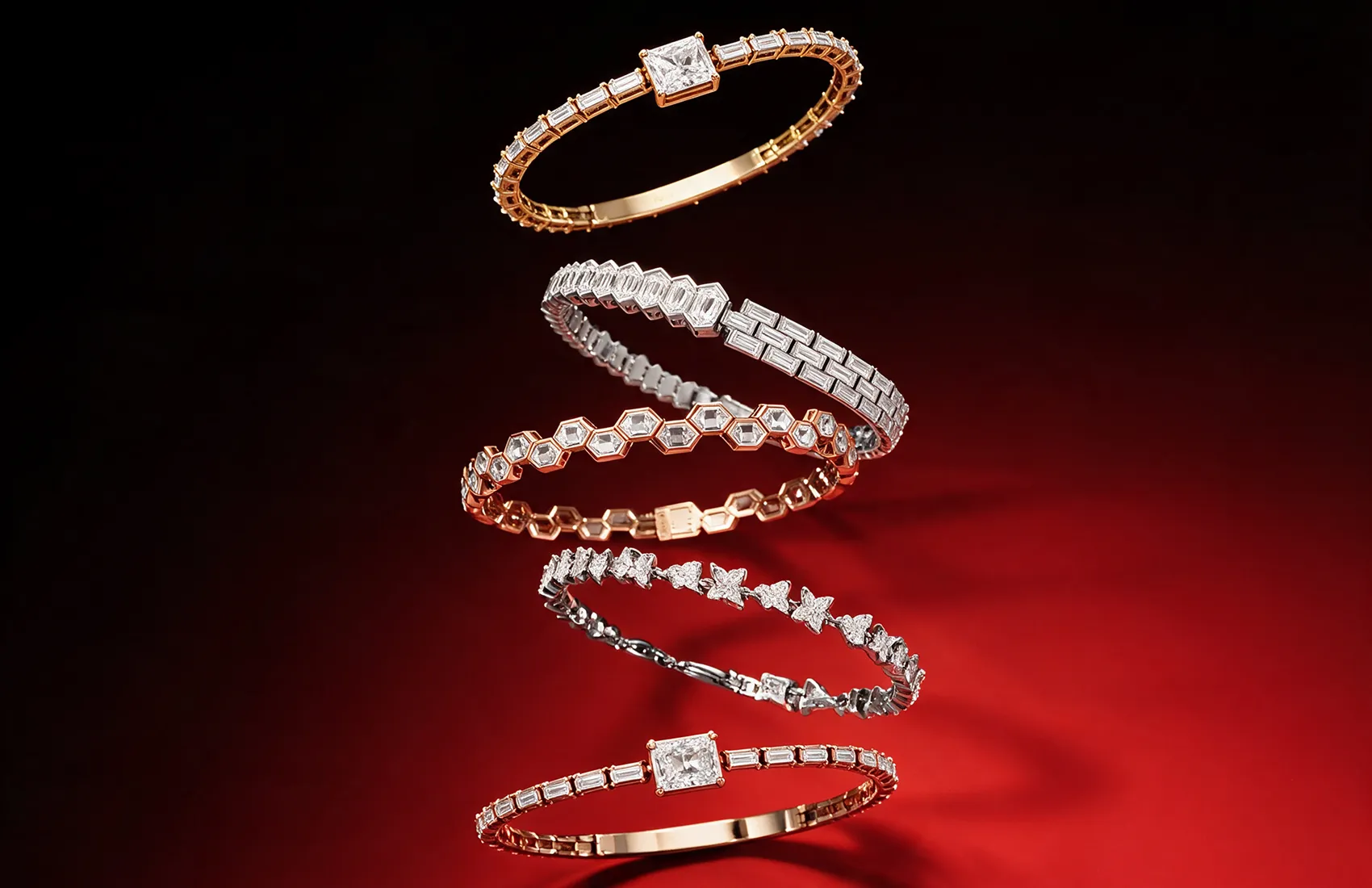
Today, mixed gold jewellery is everywhere. You can see it in stacked rings, layered chains, two-tone bracelets, and diamond earrings that bring together different gold tones. Yellow gold adds warmth, white gold gives a clean and polished look, and rose gold brings a soft, romantic tone.
But mixing gold is not just about putting different colours together. Yellow, white, and rose gold get their colour from different alloy compositions. That means they can also differ slightly in hardness, finish, maintenance, and the way they look around diamonds.
So yes, you can mix them. But when you understand how each metal works, your styling looks more thoughtful and less random.
How Can Different Gold Colours Be Worn Together?
The easiest way to mix gold tones is to make the combination look planned.
-
Start with one anchor piece.
Choose one main piece that brings the look together, such as a two-tone ring, diamond bracelet, mixed-metal pendant, or diamond earrings. This becomes the base for the rest of your jewellery. -
Repeat one gold tone.
If you are wearing a yellow gold chain with white gold earrings, repeat either yellow or white gold through a ring or bracelet. Repetition makes the mix look intentional. -
Choose one dominant metal.
Do not give yellow gold, white gold, and rose gold equal weight everywhere. Keep one metal as the main tone and use the others as accents. -
Use diamonds as the connector.
A diamond ring, pendant, bracelet, or pair of earrings can tie different gold tones together. Diamonds work beautifully with yellow, white, and rose gold, so the overall look feels balanced. -
Balance jewellery across the body.
If you mix metals around the neck, repeat one of those tones on the hand, wrist, or ears. This creates visual flow instead of making each piece look separate. -
Keep heavy pieces in the same tone.
If you are wearing bold jewellery, keep the larger pieces in one metal colour. Use smaller pieces in another gold tone to add contrast without making the look too busy. -
Check comfort when stacking.
For rings and bracelets, make sure the pieces sit well together. They should not rub too much, feel tight, or press against delicate diamond settings.
Why Karat Matters When Mixing Gold
When we mix gold, the focus is usually entirely on colour. But karat deserves attention too. Karat tells us how much pure gold is present in the alloy.
18KT gold contains 75% pure gold, which gives it a richer gold tone and a more premium feel. 9KT gold contains 37.5% pure gold and a higher proportion of alloy metals, which can make it a practical choice for regular wear.
Both 9KT and 18KT gold can be styled beautifully with yellow gold, white gold, rose gold, and lab-grown diamonds. The important thing is to choose pieces that sit comfortably together, especially when you are stacking rings or layering bracelets.
Mixing Gold Around Diamonds
Diamonds make mixed gold jewellery easier to style because they work beautifully with all three gold tones.
A lab-grown diamond has the same crystal structure, chemical composition, optical properties, and hardness as a mined diamond. Its brilliance responds beautifully to yellow gold, white gold, and rose gold.
White gold creates a cool frame around the diamond and can make the stone look bright and clean.
Yellow gold creates warmer contrast, which can make the diamond stand out more clearly against the setting.
Rose gold adds a softer tone and pairs beautifully with colourless or near-colourless diamonds.
This is why two-tone diamond jewellery works so well. For example, a ring may have a yellow gold band with white gold prongs around the centre diamond. The white prongs blend more softly around the diamond, while the yellow band adds warmth to the overall design.
There Is No Need to Choose Just One Gold Colour
Mixing jewellery gives you more ways to wear what you already love. And when diamonds are involved, the mix becomes even easier because their brilliance connects all three gold tones beautifully.
At Mayavé, our lab-grown diamond jewellery combines thoughtful design with carefully crafted gold settings, giving you the freedom to build a collection that does not follow a single-metal rule.
Whether you love yellow gold, white gold, rose gold, or all three together, your jewellery should feel personal to you.
Explore Mayavé Lab Grown Diamond Jewellery and discover pieces that let you mix, layer, and style gold in your own way.
Frequently Asked Questions
1. Can yellow gold and white gold rings be worn together every day?
Yes. The different colours do not create a problem when worn together. However, rings that constantly rub against each other can develop surface scratches over time. Check that diamond settings or sharp edges are not repeatedly rubbing against the neighbouring ring.
2. Is it better to mix gold jewellery of the same karat?
It is not compulsory, but matching karats can provide more consistent hardness and wear, particularly in tightly stacked rings. A 14K and 18K piece can still be worn together, but their alloy compositions and hardness may differ.
3. Why does white gold sometimes start looking slightly yellow?
Most white gold jewellery is rhodium plated to create its bright-white finish. As that coating gradually wears, the warmer tone of the underlying white gold alloy can become more visible. Professional rhodium replating can restore the brighter finish.
4. Can lab-grown diamonds be worn with yellow, white, and rose gold?
Yes. Lab-grown diamonds have the same chemical and optical properties as mined diamonds and work beautifully with all three gold colours.